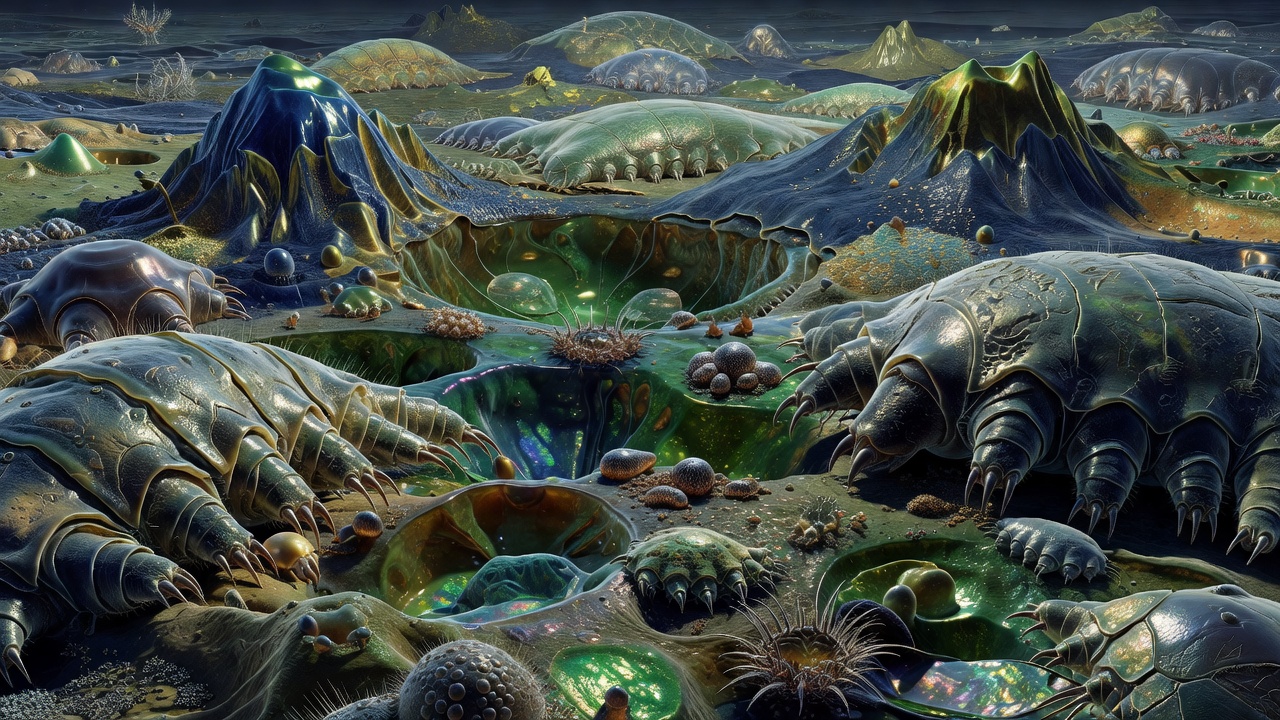
If a science fiction author invented an animal that could survive being boiled, frozen to absolute zero, crushed by the pressure of the deep ocean, dried out for decades, and blasted with ionizing radiation in the vacuum of outer space, critics would call it unrealistic. Yet, the tardigrade—often colloquially called the "water bear" or "moss piglet"—is a very real, microscopic animal that does exactly that.
Discovered in 1773 by the German zoologist Johann August Ephraim Goeze, these eight-legged micro-animals inhabit almost every environment on Earth. From the deep sea to the highest Himalayan peaks, from tropical rainforests to the Antarctic ice, tardigrades have colonized the globe. Despite their omnipresence, they remain largely invisible to the naked eye, measuring between 0.1 to 1.5 millimeters in length.
The Mechanism of Immortality: Cryptobiosis
Tardigrades are not extremophiles in the traditional sense. Extremophiles, like certain archaea, are organisms that have evolved to live and thrive optimally in extreme conditions. Tardigrades, however, do not actively thrive in extreme conditions; they merely survive them. They achieve this survival through an astonishing biological process known as cryptobiosis.
When environmental conditions become lethal—such as a complete lack of water—tardigrades curl up into a dehydrated ball called a "tun." In this state, their metabolic rate drops to less than 0.01% of normal. They synthesize a unique sugar called trehalose, as well as specific proteins known as Tardigrade-specific Intrinsically Disordered Proteins (TDPs). These molecules act like biological anti-freeze and glass, encasing the tardigrade's cellular structures and preventing cell membranes from rupturing.
Surviving the Vacuum of Space
The most famous demonstration of the tardigrade's resilience occurred in 2007 during the European Space Agency's FOTON-M3 mission. Thousands of dehydrated tardigrades were attached to the outside of the satellite and exposed to the harsh vacuum and intense ultraviolet radiation of low Earth orbit for ten days.
Vacuum exposure normally causes the water inside biological cells to boil and expand rapidly, destroying the cell walls. Furthermore, the massive dose of solar UV radiation severely damages DNA. Yet, when the satellite returned to Earth and the tardigrades were rehydrated, over 68% of the specimens exposed to the vacuum (and shielded from the highest levels of UV) revived within 30 minutes. Many went on to reproduce normally, producing healthy offspring.
Radiation Resistance and DNA Repair
How do they survive radiation levels that would turn a human into a medical anomaly? Humans can be killed by a dose of about 5 to 10 Grays of radiation. Tardigrades can withstand over 5,000 Grays. Research has shown that tardigrades have a unique protein called Dsup (Damage suppressor). This protein physically wraps around their DNA like a protective blanket, shielding it from ionizing radiation and hydroxyl radicals.
Even when their DNA is fractured by immense radiation, tardigrades possess highly efficient DNA repair mechanisms that can stitch their genome back together within days of rehydration. This extreme capability has sparked massive interest in medical research; scientists are currently investigating whether Dsup could be used to protect human cells during radiation therapy or extended spaceflight.
Where Can You Find Them?
You don't need a deep-sea submersible or a rocket to find a tardigrade. They are most commonly found in the thin films of water that coat mosses, lichens, and leaf litter. If you take a piece of moss from a damp brick wall, soak it in water for a few hours, and squeeze the water into a petri dish, examining it under a low-power microscope will almost certainly reveal a water bear lumbering across the field of view on its eight clawed legs.
| Survival Threat | Human Limit | Tardigrade Limit |
|---|---|---|
| Temperature (Low) | ~ 0°C (Hypothermia) | -272°C (1 degree above Absolute Zero) |
| Temperature (High) | ~ 45°C (Heatstroke) | 150°C (Well above boiling water) |
| Pressure | ~ 30-40 Atmospheres (Diving limit) | 6,000 Atmospheres (6x Marianas Trench pressure) |
| Radiation | 5 - 10 Grays | 5,000+ Grays |
As scientists continue to study these remarkable creatures, the definition of what constitutes a habitable environment in our universe continues to expand. The indestructible nature of the tardigrade proves that life, when pushed to the extreme, possesses engineering mechanisms far more advanced than anything humans have yet artificially created.